I've just been reading this post on Naked Capitalism, which raised the question of how much land you need to feed a person. In the past I've seen numbers in the range of 1 - 2 acres per person, but do you really need that much?
I think working out the answer is a bit complicated, but I thought I'd start with something simple. What yield would a 1 acre apple orchard give in the UK? Apple trees on MM106 are supposed to yield 30 - 60 kg a year on average when fully grown, and be about 4m wide. That means that one tree covers 12.57 m2.
Now, an orchard doesn't have a closed canopy, so lets say that the canopy area is 50% of the ground area. That means that in an acre you can fit 159 trees, with a yield between 4.8 and 9.5 metric tonnes. That is 13 - 26 kg of apples a day, and each kg contains about 10 apples. Of course, you can't eat the apples evenly through the year without some method of preservation, but let's pretend that you can.
Next, an apple contains about 50 calories. 13 kg of apples is therefore 13 * 10 * 50 = 6500 calories. The average intake for a man should be around 2500, so this is far more than required. If we only care about energy, and ignore all the other nutrients people need, then our hypothetical man in fact needs at most 0.4 acres, and perhaps as little as 0.2 acres.
Of course, this is a massive simplification, for a few reasons. These are:
1. No-one would try to survive by eating 5 kg of apples a day
2. This assumes that the yield can be consumed evenly throughout the year
3. It assumes that there is no spoilage in storage
4. It assumes that there is no need to worry about variations in yield due to weather etc.
5. It assumes that all that matters is energy, and not other nutrients
6. It assumes that there is no need for additional land to grow fertility / mulch materials
But allowing for some pessimism, land to grow a bit of food for chickens (meat/eggs) etc., 1 acre per person for a good diet does seem like it might be about the right answer for the UK.
Another way to approach the problem is to divide the total amount of agricultural land in the world by the number of people (it doesn't work for individual countries due to food imports, but luckily the world as a whole doesn't import any food) . This gives an answer of 1.8 acres per person, based on numbers from Wikipedia. But again, this answer is imperfect for any particular place because of wide variations in climate across the globe, and because the world's land isn't used to produce a healthy, sustainable diet in the most efficient way possible. This is obvious since on the one hand we have overconsumption of luxury foods like meat in much of the world, and hunger in much of the rest. In addition, the current agricultural system relies on massive injections of mined / artificial nutrients, so a sustainable system could actually require more than 1.8 acres per person at a global level.
So what's the right number? A minimum is probably at least 0.5 acres per person. A realistic number with a bit of meat/eggs is probably more than 1 acre per person. How much more I'm not sure.
Showing posts with label gardening. Show all posts
Showing posts with label gardening. Show all posts
Thursday, 24 April 2014

Tuesday, 8 April 2014
Sweet Cicely
 |
| Sweet Cicely growing through plastic mulch |
I first bought a sweet cicely plant from the a market stall of the Herb Nursery, about 2 and a half years ago. I'd previously read about it in various gardening books, and I have to say that despite its relative lack of availability in garden centres it does live up to its good reputation. The leaves, young seeds and roots are all edible with a delicious sweet anise flavour. And when I say sweet, I mean sweet - the young seeds taste like crunchy Black Jacks, which were one of my favourite sweets as a child.
It's quite a pretty herb, pollinators love the flowers, and it will quite happily live in shady damp corners. In fact, when I tried growing it in full sun it looked seriously unhappy by summer, so it's definitely a plant for the shade. But doesn't everyone have some shade? And since most other herbs have 'full sun' on the label, having such a good one for those awkward places is really nice.
So why can't you buy it everywhere? The only possible issue I've seen is that it's supposedly difficult to get the seeds to germinate, as they need a period of cold. But I've not had any issues growing sweet cicely from seed as long as that need is met - in 2012 I stratified the seeds in the fridge, but last year I just planted them in autumn and left them in the garage all winter.
Wednesday, 2 April 2014
Medlar leaves
Of all the fruit trees that I planted, the one I've been keeping the closest eye on is the medlar. The leaf buds have been getting gradually bigger over the last few weeks, but over the last day or two they've finally started to open! You can see the tree in the picture below:
 |
| My Iranian medlar from Keepers Nursery |
 |
| The medlar is leafing out! |
1. picking time
2. disease resistance
3. yield
4. reliability
5. storage duration for the fruit
6. ability to fertilise other trees I ordered
Of course, each one was a compromise, but the main emphasis was on usefulness and reliability.
The medlar was a bit different. I know that I like jelly made from the fruit, although I've not tried it raw. In fact, I love the jelly - I would say it is much better than quince jelly, which seems to have the better reputation in general. But in most of the world it is not grown much any more for its fruit, so finding reliable numbers for yield is quite hard. Does it provide more than an apple tree in its place would, or a pear tree? Does the fruit store as well as a late-keeping apple? Doubtful on both counts. But I don't really care too much, because out of the trees the medlar was my 'something slightly different and interesting'.
So what does the medlar offer? In addition to the unusual and not widely available fruit (unless you're from Iran or Europe a few centuries ago), it is quite a pretty tree with zigzagging branches and a lot of colour in autumn. Despite its origin around the Middle East, it also has a history in this country, so it's something to talk about when people ask what it is.
The 'Iranian' variety which I've planted is from Keepers Nursery. The family who run the nursery are Iranian themselves, where the fruit is still quite popular, and have a relatively large range of different varieties. Their 7 varieties beats the usual 1 - 3 of other fruit tree nurseries. Here's what they say about the Iranian medlar, which they introduced themselves:
Iranian Medlar is a dessert variety introduced by Keepers Nursery. It originates from the wild medlars which grow in the Alborz Mountains in northern Iran. It is widely grown in Iran where it is a traditional and popular late autumn and early winter fruit.I chose this variety because I do want to try eating the fruit raw, so good flavour is attractive, because they say it is compact (Medlars tend to be spreading trees), and because well, again it's something different. As far as I know, no other nursery has taken up selling the Iranian medlar variety yet, preferring to stick to the more well known Nottingham and/or Royal varieties. Of course, the Iranian variety might not live up to the description, but I guess I'll find out in a few years.
The fruit is slightly smaller than most other varieties of medlar and rather more conical in shape. It is the one of the best flavoured medlars. In common with other medlars the fruit has a brown russet skin. The flesh is quite hard and green until it is fully ripe when it turns brown in colour and becomes soft. It is quite sweet with a texture and flavour similar to a thick apple puree. It ripens earlier than other varieties. It can be left on the tree to ripen in November or picked prior to ripening and allowed to ripen in storage. The ripe fruit can be frozen and eaten fresh after defrosting.
The tree is compact with a bushy growth habit. It crops very well and does not have any major disease or pest problems. It has attractive large white blossom in May. Unlike most fruit trees medlar blossom opens after the leaves.
Sunday, 30 March 2014
Raised beds
 |
| The first raised bed - surrounded by Raspberries/Blackberries/herbs/skirret/pear trees |
Of course, I also had to fill it. I turned over the turf underneath the bed and loosed up the soil a bit, which filled out the bottom a bit since when you dig over the soil always expands. I also chucked in soil from a number of empty containers I had standing around. But still, the bed was mostly empty and I didn't have any more soil available.
A bed that size with a depth of 24cm has a volume of 0.24 x 2.6 x 1 = 0.624 m3. Since there are 1000 litres in one m3, this means I needed around 600 litres of soil. Not having any good quality soil free, I bought 600 litres of top soil, compost and manure from the garden centre for about £60 and mixed it together.
So the question now is, what's the best annual veg to plant in my new 2.6 m2 raised bed? I do plan to build at least one more, but we don't have much more free cash right now so it might be another month before I can.
Thursday, 27 March 2014
Is Chinese Rhubarb safe to eat?
 |
| Chinese Rhubarb - Rheum Palmatum Tanguticum |
On one side are a number of forest garden and permaculture sites. For example, PFAF has this to say:
Leaf stem - raw or cooked[2, 7, 105, 183]. The stem is superior in flavour to the common rhubarb and quite tender[2]. An acid flavour, it is sometimes used as a cooked fruit substitute[K].Similarly, the same plant is being sold by Martin Crawford with the following description:
The Gardeners' World website also explicitly says that the plant is edible:Rhubarb (Rheum palmatum) TurkishRheum palmatum. A large perennial from Mongolia, growing to 1.5 m (5 ft) across and 3 m (10 ft) high with very large leaves. Grow in any moist, well-drained soil in sun or shade. Makes a good ground covering plant, and the leaf stalks are edible in the same way as ordinary rhubarb, with a superior flavour; the roots are used medicinally. Hardy to -20ºC.Rhubarb (Rheum palmatum tanguticum) Turkish RedA variety of Turkish rhubarb with reddish stalks and leaves.
The large, jagged leaves of this rhubarb bring architectural drama to a moist pond edge. As well as being a valuble ornamental plant, its red stems are full of flavour, making this a variety well worth growing as an edible crop. Divide the rootstock in spring with a knife, leaving one bud on each division, or sow seed in autumn.On the other hand, Wikipedia makes no mention of the leaf stems being edible (although it does discuss medical uses of the root and rhizomes), and a number of sites selling this species as an ornamental explicitly warn that it shouldn't be eaten. For example:
Please note: this is an ornamental plant that does not offer any edible produce. Although it is related to the common garden rhubarb plant, it does not produce the same edible red stems. This plant has no edible parts and the leaves are actually poisonous if consumed, as with all varieties of rhubarb.I am inclined to trust PFAF and Martin, but I think perhaps the first time I will try a small amount just to make sure.
Wednesday, 19 March 2014
This year's hard-to-find plants
Most of the things I've either planted or bought to plant this year were available from lots of different sources. But there were two that were actually quite hard to track down, for reasons that I don't really understand. This year's hard-to-find plants were:
Hablitzia Tamnoides 'Caucasian Spinach'
This plant is a relative of the goosefoot family, and is therefore related to food plants like Good King Henry. Its supposed advantages are that it grows rapidly, producing lots of edible leaves early in the season, it's relatively shade tolerant, and it's perennial. See here for an article written by a fan.
But while growing Good King Henry from seed is easy, this plant is an odd combination of popular and impossible to obtain. On the one hand, it has a group of fans so keen that they've set up a facebook fan group called Friends of Hablitzia Tamnoides, the Caucasian Spinach. On the other hand, the RHS plant finder only knows of three places that sell the plant, and at least one of them no longer sells it.
Luckily, one of those places was Cool Temperate, which I've bought plants from before. Unluckily, when I contacted Phil he told me that the only plants he had had been waterlogged by the wet weather to the point of death. Since I had no other source, I bought one anyway, hoped, and this happened in the last few days:
Aralia Cordata 'Udo'
Udo, also called 'mountain asparagus', is apparently a popular perennial vegetable in Japan. As the alternative name suggests, the shoots are eaten in spring. Despite its popularity there, and its shade tolerance (a rare quality in vegetables), it is almost impossible to buy here in the UK. And when it is available, it is only available in the form 'Sun King', a variety chosen to look nice in shady corners.
I eventually found a plant supplier called Norwell Nurseries within striking distance who sold the 'Sun King' variety. It's now started growing too, and I've got the perfect spot for it in the shady area north of the garage. I just hope that the ornamental 'Sun King' variety is as good for eating as the varieties grown in Japan.
Elaeagnus Multiflora - Goumi
Goumi is a medium sized shrub that produces small red edible fruits. Its main advantage is that it falls into the small class of shrubs that:
Hablitzia Tamnoides 'Caucasian Spinach'
This plant is a relative of the goosefoot family, and is therefore related to food plants like Good King Henry. Its supposed advantages are that it grows rapidly, producing lots of edible leaves early in the season, it's relatively shade tolerant, and it's perennial. See here for an article written by a fan.
But while growing Good King Henry from seed is easy, this plant is an odd combination of popular and impossible to obtain. On the one hand, it has a group of fans so keen that they've set up a facebook fan group called Friends of Hablitzia Tamnoides, the Caucasian Spinach. On the other hand, the RHS plant finder only knows of three places that sell the plant, and at least one of them no longer sells it.
Luckily, one of those places was Cool Temperate, which I've bought plants from before. Unluckily, when I contacted Phil he told me that the only plants he had had been waterlogged by the wet weather to the point of death. Since I had no other source, I bought one anyway, hoped, and this happened in the last few days:
 |
| Hablitzia Tamnoides 'Caucasian Spinach' |
Aralia Cordata 'Udo'
Udo, also called 'mountain asparagus', is apparently a popular perennial vegetable in Japan. As the alternative name suggests, the shoots are eaten in spring. Despite its popularity there, and its shade tolerance (a rare quality in vegetables), it is almost impossible to buy here in the UK. And when it is available, it is only available in the form 'Sun King', a variety chosen to look nice in shady corners.
I eventually found a plant supplier called Norwell Nurseries within striking distance who sold the 'Sun King' variety. It's now started growing too, and I've got the perfect spot for it in the shady area north of the garage. I just hope that the ornamental 'Sun King' variety is as good for eating as the varieties grown in Japan.
 |
| Aralia Cordata 'Sun King' |
Elaeagnus Multiflora - Goumi
Goumi is a medium sized shrub that produces small red edible fruits. Its main advantage is that it falls into the small class of shrubs that:
1. Fix nitrogen without growing too large
2. Also produce something edible
In a medium sized garden, there isn't a lot of space available to be devoted to exclusively nitrogen-fixing plants, so a multi-purpose plant is a great find. Most other fruiting nitrogen fixing shrubs are a bit on the big size - examples of larger plants would be other members of the Elaeagnus family (e.g. Autumn Olive), or Sea Buckthorn.
The problem is that, while better fruiting forms have been selected, getting hold of them in the UK is hard. If you google the most common improved varieties, 'Sweet Scarlet' and 'Red Gem', you'll find hundreds of sellers in the US and basically none in the UK. In fact, in the UK is hard to even find people selling unimproved varieties. This despite the fact that according to PFAF it will bear fruit heavily here. I guess that the mainstream has yet to be convinced about the benefits of nitrogen fixing plants.
The only seller of 'Sweet Scarlet' that I know of in the UK is Martin Crawford of the Agroforestry Research Trust. And he obviously can't meet demand, since I tried to order 3 and he only had one left to send! Next year I might order another one...
 |
| The Goumi in my garden - guarded by mesh just in case! |
Sunday, 16 March 2014
Global gardens
I was thinking earlier today about the diverse origins of the various plants in our garden. The following is off the top of my head with a bit of googling where I wasn't sure:
North America
Saskatoon
Oregon Grape
Jerusalem Artichokes
Aronias / Chokeberries
South America
Fuchsia
Asia
Goumi
Goji berry
Apple - according to Wikipedia, the main ancestor of malus domestica grows in Kazakhstan.
Pear (?) - according to Wikipedia, the genus originates in China, but it's been widespread across Europe and Asia for a long time
Rugosa Rose
Blueberry Honeysuckle
Flowering quinces
Japanese wineberry
Middle East
Medlar - still popular in Iran!
Europe
Pear (?) - Pears have been in Europe for a long time, but the genus originates in China
Plum (?) - Does anyone know the exact origin of prunus domestica? It's assumed to be some kind of hybrid...
Cherry
Rosemary
Sage
Thyme
Blackcurrant - also in parts of Asia
Red/whitecurrant
Sweet Cicely
Lemon Balm
Bay Tree
Widespread
Raspberries - various native species across much of the world
Blackberries - various native species across much of the world
Gooseberry - Europe and parts of Africa and Asia. I think there is some cross-breeding with related American species for disease-resistant cultivated varieties.
St John's Wort - across Europe and Asia
Admittedly the list of European plants is longest, which is what you might expect since the UK is part of Europe. But I think it's quite impressive how many of the plants are actually from a very long way away from here originally.
Jerusalem Artichokes
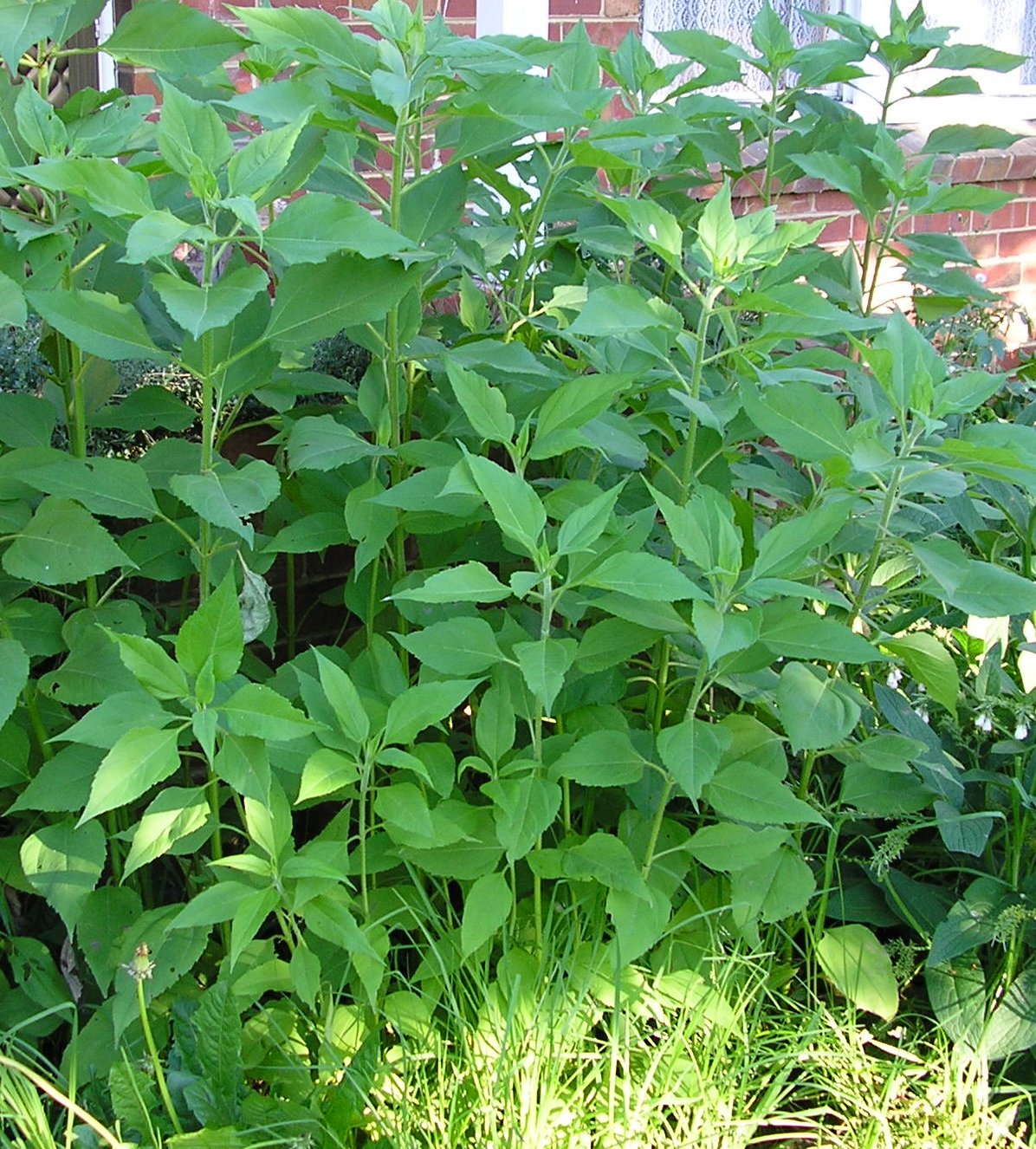 |
| Jerusalem Artichokes - At best a distant relation to true artichokes |
Having tracked them down, I had to decide where to plant them. And this is where I hit contradictory advice. One of the things which originally attracted me to Jerusalem Artichokes was that numerous sources described them as:
1. Prolific / high yielding
2. Unpicky as to site / soil
3. Tolerating partial shade
4. Spreading to a form a dense cover, invasive if not controlled
5. Casting dense shade below that suppresses (other!) weeds
For example, here is what Patrick Whitefield has to say about them:
The best place for them is either just to the north of the forest garden where the ground is shaded by the trees, or in some place that is shaded by buildings or other tall vegetation. An acquaintance of mine who had an awkward patch in his garden, overshaded by laurel bushes, found that Jerusalem artichokes were the only food plant he could grow there with any success.
...
They are very tough plants, tolerant of poor soils and needing little in the way of cultivation.With this idea of their requirements, I had planned to put them in a slightly shady corner, between two hedges, currently overrun with ground elder. My cunning plan was to use them as a crop of last resort for a difficult area, and to try to use them as a barrier to either keep the ground elder in that corner or at least slow down its spread a bit. I had a good two or three square meters partially cleared and ready to go.
But then I read the planting advice on the packet containing the tubers. This advice could be summarised as:
1. Plant them somewhere sunny
2. Keep soil around them moist
3. Keep the soil around them clear of weeds
4. Feed them with compost, manure or fertiliser
This could basically be summarised as "coddle the plants". This is a far cry from a lot of what you can read online, which describes the plants as basically indestructible.
So which set of requirements is correct? It seems to be quite common in gardening that one and the same plant can be described in very different terms by different sources. I think that this is basically because there are so many variables involved that often it's not clear why a plant succeeds in one location but not another, and people then incorrectly extrapolate from their experience. In the case of plant suppliers, I think they also tend to play it safe to avoid complaints.
Anyway, I decided to just go ahead and give it a try. 15 tubers are now planted in my slightly shady three square meters, partially cleared but with ground elder roots still lurking in there somewhere. Hopefully I'll be able to report a dense Jerusalem Artichoke thicket in a few months.
Tuesday, 24 December 2013
Oca
 |
| A bowl of Oca tubers harvested today |
In terms of the main edible part, the tubers, I guess my review would be a bit mixed. Firstly, I think the yield was a little disappointing - each of my big pots with three tubers in yielded about two bowls of tubers as shown in the picture above. While this is probably about 10x as many tubers as I originally planted, I think that the yield is probably not as good as I would have got from potatoes.
The yields might have been suppressed a bit because we moved house in September, and because I had so many other things to do the Oca ended up being left in a slightly shady corner for a long time. Since Oca mostly forms its tubers late in the year, a reduction in sunshine might have hit yields. On the other hand, frosts came very late this year in Nottingham - I don't recall seeing any ground frost until late November, thanks to such a warm late Summer and Autumn. In a normal year the Oca would have died back probably a month earlier I guess, which I've read would probably also reduce the yield.
In terms of taste, I've tried the tubers raw and boiled. Raw, I wouldn't bother - there isn't much of a taste, although the tubers do have a crunchy texture. Boiled, they were much nicer - the skin tastes lemony, and the inside becomes very soft and floury with a taste mostly like a potato but slightly less sweet. I would say that the hint of lemon from the skin was quite a nice contrast to the flesh.
So far we have:
- attractive plant
- yield probably not as good as potatoes
- taste similar to potato but slightly less sweet, with a lemony skin
I guess Oca has one more benefit, which is that most of its diseases aren't common currently in the UK. I believe that it's immune to diseases like potato blight, and since no-one else nearby is likely to be growing it, the chance of infection with its own pests and diseases should be low. This means that saving and replanting tubers is likely to be less risky than for potatoes.
So will I grow it again next year? I think I will try, using some of the tubers I've dug up this year. There is very little cost to me of doing so, and it is quite a nice looking plant. The main reason not to bother is the yield - I don't think it was amazing this year, and that was after a long warm Autumn. If we have more typical weather next year, I'll be looking to see if the yield is about the same or significantly worse before deciding whether it will make it to year 3 in the garden.
Subscribe to:
Posts (Atom)