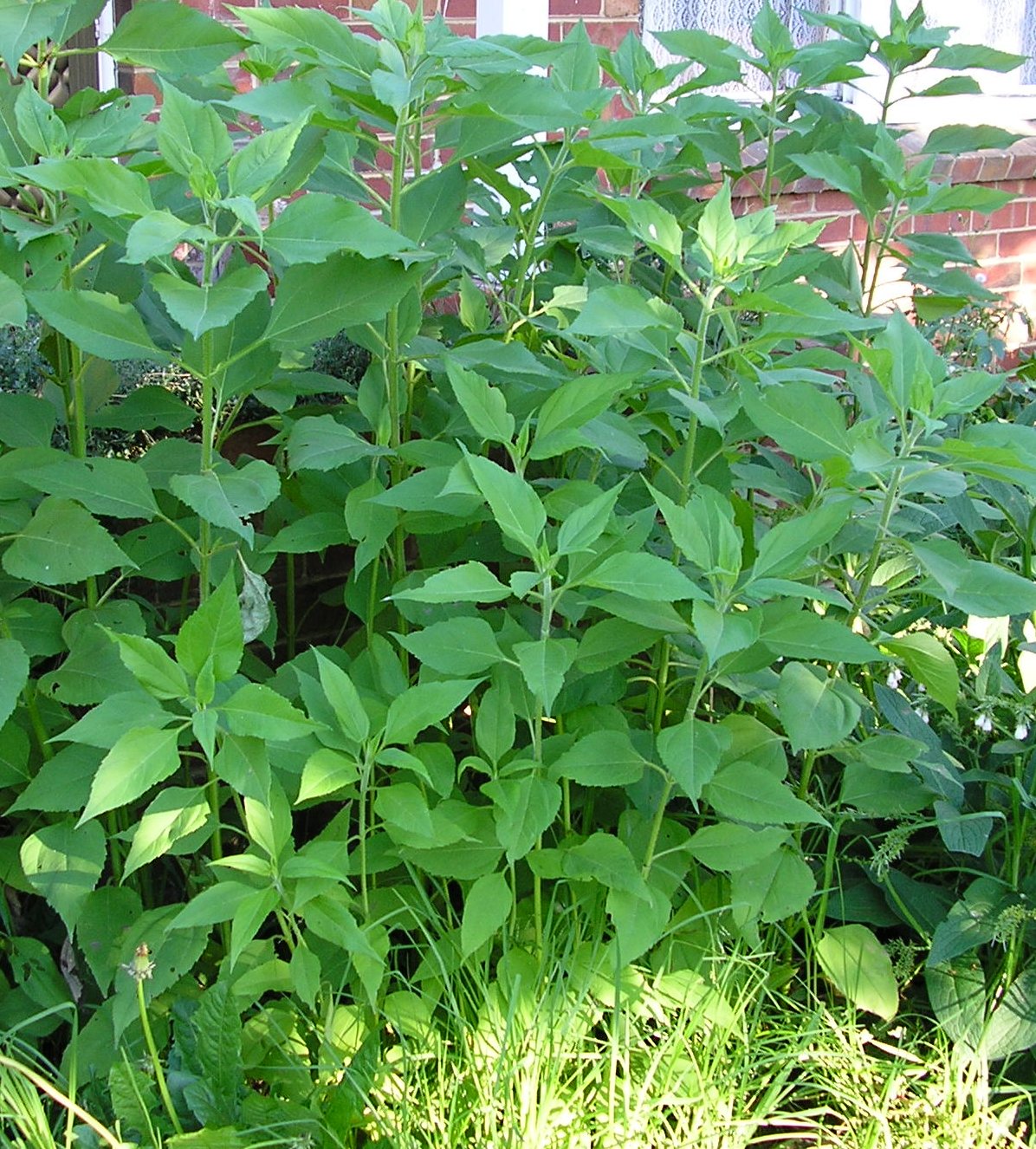
Continuing on the theme of strongly scented plants, and to balance out the case of the unscented philadelphus, here's a picture of a plant whose scent was a bit unexpectedly strong:
It's sea kale. This is a plant I've tried to grow for years more for its use as a vegetable than anything else. The seed has a corky outer coating that floats but also makes germination a bit tricky. I managed to grow two plants from seed, but those never did well and died out pretty quickly. My current plants come from a very traditional plant nursery (no cafes, garden furniture or scented bath soaps!) that I visit when I get the chance.
What got these plants to thrive is being planted in a bottomless pot. I think sea kale needs better drainage that most of my garden offers and nice deep soil. The bottomless pots solve both issues nicely: I honestly don't know why you can't buy these more easily, but I made my own with an angle grinder.
And then after all that effort, this year one of my plants actually flowered. And it is very attractive: the thick grey brassica leaves and the masses of white flowers make it the equal of any other ornamental when in bloom. But the scent... I could smell it from three or four meters away, which I didn't expect, and I wasn't sure I liked it.
Most descriptions describe the scent as honey, but the combination of strong sickly sweetness with a slight hint of sourness brought to mind sweat or something rotting for me. It's the same not quite pleasant combination that many fly pollinated flowers have, although I'm not sure which insects the sea kale was trying to attract. I asked the other half for her opinion to check it wasn't just me, and she leaned more towards "honey" than I did, but "fake chemical honey".
So there you go.
Thursday, 31 May 2018
Sunday, 27 May 2018
Ephemeral Flowers and Subjective Scents
After a brief but very odorous time in the spotlight, the lilacs are starting to go downhill. The Palabin and Miss Kim are starting to pale and then go brown. Here's a picture of the Miss Kim in her pot, waiting to be planted in the front garden when it exists:
The flowering period might be short, but it is glorious. You can often smell the scent from 3+m away at the front door.
The plan is to take up a triangle of concrete at the front to make green space in front of the house. Over the last year or two I've been collecting shrubs, many of the scented, many of them for autumn/winter interest, for the garden to be.
The thing about front gardens is they're a different beast to back gardens. Unless they're very big they don't offer any privacy, so you're not going to sit in them, or stroll through them. But what you are going to do is walk past them every single day on your way in and out. Our back garden is very much a summer garden, filled with deciduous shrubs and herbaceous perennials, so I hope the front can be something to bring a bit of planty goodness to our lives when it's cold and dark.
There have been a few bumps in the road of this plan though. Scent is quite hard to prove before purchase. Unless you buy the plant in bloom, you're going on a text description of how scented it is. There's no such thing as a scent picture, and suppliers don't normally add scratch and sniff panels to plant labels. And it's also quite subjective: my wife, who otherwise has a good nose for scent, swears that Viola odorata is scentless, but I can smell it from meters away if the wind is blowing in the right direction.
Which brings me to Philadelphus 'Manteau d'Hermine'. Everyone knows that philadelphuses are strongly scented, and most suppliers claim that 'Manteau d'Hermine' is too. Unfortunately, the flowers seem completely scentless to me, and my wife can only detect a faint scent if the flower's right in front of her nose. Here is the offending shrub:
I can tolerance a short, single flush of flowers if the show is spectacular. Unfortunately, a scentless philadelphus is just disappointing. If this particular plant doesn't do better next season, I think it'll be off to the giant compost heap in the sky...
| Miss Kim lilac in its pot |
The flowering period might be short, but it is glorious. You can often smell the scent from 3+m away at the front door.
The plan is to take up a triangle of concrete at the front to make green space in front of the house. Over the last year or two I've been collecting shrubs, many of the scented, many of them for autumn/winter interest, for the garden to be.
The thing about front gardens is they're a different beast to back gardens. Unless they're very big they don't offer any privacy, so you're not going to sit in them, or stroll through them. But what you are going to do is walk past them every single day on your way in and out. Our back garden is very much a summer garden, filled with deciduous shrubs and herbaceous perennials, so I hope the front can be something to bring a bit of planty goodness to our lives when it's cold and dark.
There have been a few bumps in the road of this plan though. Scent is quite hard to prove before purchase. Unless you buy the plant in bloom, you're going on a text description of how scented it is. There's no such thing as a scent picture, and suppliers don't normally add scratch and sniff panels to plant labels. And it's also quite subjective: my wife, who otherwise has a good nose for scent, swears that Viola odorata is scentless, but I can smell it from meters away if the wind is blowing in the right direction.
Which brings me to Philadelphus 'Manteau d'Hermine'. Everyone knows that philadelphuses are strongly scented, and most suppliers claim that 'Manteau d'Hermine' is too. Unfortunately, the flowers seem completely scentless to me, and my wife can only detect a faint scent if the flower's right in front of her nose. Here is the offending shrub:
| To smell or not to smell, that is the question |
Saturday, 26 May 2018
Hope
People who've read my previous blog will know that I'm a big fan of medlars, both the tree and the fruit. It's been a source of sadness to me that I've had very limited success so far growing the fruit at home.
It's not that I don't have a medlar tree. The very first winter after we moved in I planted a bare-root Iranian medlar, which is now in its fifth year. And it's not that it doesn't flower. It does, but in previous years fruit set has been poor and many of the fruits have fallen off before ripening.
This year, though, this year... it's covered in flowers, and they look bigger than in previous years. Hope springs eternal, and I'm crossing my fingers that this year it will actually produce a decent crop of fruit.
If not, it's still a beautiful tree. Even my wife, who isn't always the most plant-aware person in the world, remarked on how nice it looked the other day. And I do have the backup plan of the Royal medlar I planted this winter just gone on the other side of the garden. Did I mention that I really like medlars?
It's not that I don't have a medlar tree. The very first winter after we moved in I planted a bare-root Iranian medlar, which is now in its fifth year. And it's not that it doesn't flower. It does, but in previous years fruit set has been poor and many of the fruits have fallen off before ripening.
This year, though, this year... it's covered in flowers, and they look bigger than in previous years. Hope springs eternal, and I'm crossing my fingers that this year it will actually produce a decent crop of fruit.
| My medlar tree in bloom |
Wednesday, 23 May 2018
A Very Continental Spring
Anyone who's been around the last few months has probably noticed the very abrupt transition between winter and spring this year. The 'Beast from the East' meant we had fewer warm spells in early and mid-Spring than usual, and was followed in late April / early May by a blast of heat which broke records on the bank holiday. In my garden, we went from regular night-time frosts to no frosts with basically no transitional period in between.
This is a very continental climate pattern. Great Britain, being an island at high latitudes, has an oceanic climate moderated by the sea but very influenced by atmospheric conditions like the polar jet stream. In the winter and spring we can switch between blasts of cold arctic air and mild air from the south in days. A continental climate, far from the sea, tends to have colder winters, hotter summers, and a much clearer break between the two.
Despite the late arrival of good weather, a lot of the plants in the garden have actually been pretty happy. My Actinidia kolomiktas have never had it so good. A. kolomikta, also called 'Arctic Kiwi', is one of the northern-most kiwi species, and can withstand very cold temperatures when dormant. Unfortunately, though, once it starts growing in spring the new shoots are not very frost tolerant.
The last three years, the plants haven't even made it to the top of the arches they're planted against and every year the flowers (and fruit) have been lost to frost. This year, they held off on growing until after the Beast and are growing a mile a minute. Flowers are open, fruits are forming, and I might finally get to taste some hardy kiwis!
Below are some pictures of the flowers. The species is dioecious (there are male and female plants), and most commonly the males are grown as ornamentals because of their green, pink and white coloured leaves. You can clearly see the difference in the flowers if you look.
The scent is lemony and definitely noticeable. It wafts through the air under the arches and catches you as you walk through.
I think the plants have earned a reprieve from the threat of removal. I am hoping that eventually they'll get big and dense enough that a bit of frost doesn't knock back everything, just the outer layer(s)...
This is a very continental climate pattern. Great Britain, being an island at high latitudes, has an oceanic climate moderated by the sea but very influenced by atmospheric conditions like the polar jet stream. In the winter and spring we can switch between blasts of cold arctic air and mild air from the south in days. A continental climate, far from the sea, tends to have colder winters, hotter summers, and a much clearer break between the two.
Despite the late arrival of good weather, a lot of the plants in the garden have actually been pretty happy. My Actinidia kolomiktas have never had it so good. A. kolomikta, also called 'Arctic Kiwi', is one of the northern-most kiwi species, and can withstand very cold temperatures when dormant. Unfortunately, though, once it starts growing in spring the new shoots are not very frost tolerant.
The last three years, the plants haven't even made it to the top of the arches they're planted against and every year the flowers (and fruit) have been lost to frost. This year, they held off on growing until after the Beast and are growing a mile a minute. Flowers are open, fruits are forming, and I might finally get to taste some hardy kiwis!
Below are some pictures of the flowers. The species is dioecious (there are male and female plants), and most commonly the males are grown as ornamentals because of their green, pink and white coloured leaves. You can clearly see the difference in the flowers if you look.
| Female A. kolomikta flowers |
| Male A. kolomikta flowers |
The scent is lemony and definitely noticeable. It wafts through the air under the arches and catches you as you walk through.
I think the plants have earned a reprieve from the threat of removal. I am hoping that eventually they'll get big and dense enough that a bit of frost doesn't knock back everything, just the outer layer(s)...
Monday, 21 May 2018
Back
So, I've decided to switch back to Blogger. For a while I hosted my own blog on a Raspberry Pi in our sitting room, but limited time for maintenance meant it had a less than 100% up-time. I think it might be time for someone else to worry about routine maintenance.
And in honour of the switch back to Blogger, I'd like to mention a guest in our garden that's made an unexpected move. For the last two or three years I've had a couple of Allium ursinum bulbs (wild garlic) in a small pot, debating whether to plant them in the garden or not. On the plus side, they're edible, make a nice ground-cover in the Spring, and the white allium flowers are attractive. On the negative side, they really smell of garlic, so a dense carpet of them might just annoy the neighbours a bit.
Well, it looks like the plant itself has, unnoticed, made the decision for me. There are lots of suspiciously similar seedlings around the corner where I was keeping the pot, a few of which have even flowered. Here's a picture of a tiny plant with flowers.
It's funny how I found Allium ursinum so difficult to raise from seed in trays, but left to its own devices it self-seeds happily. And now they're there, I just don't have the heart to pull them up... I'll just wait and see if they come back bigger and stronger next year.
And in honour of the switch back to Blogger, I'd like to mention a guest in our garden that's made an unexpected move. For the last two or three years I've had a couple of Allium ursinum bulbs (wild garlic) in a small pot, debating whether to plant them in the garden or not. On the plus side, they're edible, make a nice ground-cover in the Spring, and the white allium flowers are attractive. On the negative side, they really smell of garlic, so a dense carpet of them might just annoy the neighbours a bit.
Well, it looks like the plant itself has, unnoticed, made the decision for me. There are lots of suspiciously similar seedlings around the corner where I was keeping the pot, a few of which have even flowered. Here's a picture of a tiny plant with flowers.
It's funny how I found Allium ursinum so difficult to raise from seed in trays, but left to its own devices it self-seeds happily. And now they're there, I just don't have the heart to pull them up... I'll just wait and see if they come back bigger and stronger next year.
Saturday, 31 October 2015
What do raw medlars taste like?
Today, I finally answered this question with a taste test. I'd like to say that the medlars were home grown, but my own tree unfortunately still hasn't produced any fruit, so I borrowed a couple from under the tree at Calke Abbey. After picking them up, I left them in a bowl in the conservatory until the first one turned brown and wrinkly and squishy, and here we are.
So what did it taste like? I'd summarise it as apple purée with a hint of oats and lemon juice. There was definitely a hint of lemon in there somewhere, and as for the oats... the texture and dryness of the fruit reminded me somehow of porridge. After ripening the flesh has a coarse, flaky texture, and the fruit was quite dry, both in the sense of not juicy and also due to a hint of astringency.
I'm not sure if leaving the fruit even longer would have sweetened it more, but I enjoyed it as it was. And having tasted raw medlars, I can definitely understand why people think that they go well with cheese. I think I still prefer medlars in cooked (jelly) form, but when my own tree starts producing I'm looking forward to eating more raw as well.
So what did it taste like? I'd summarise it as apple purée with a hint of oats and lemon juice. There was definitely a hint of lemon in there somewhere, and as for the oats... the texture and dryness of the fruit reminded me somehow of porridge. After ripening the flesh has a coarse, flaky texture, and the fruit was quite dry, both in the sense of not juicy and also due to a hint of astringency.
I'm not sure if leaving the fruit even longer would have sweetened it more, but I enjoyed it as it was. And having tasted raw medlars, I can definitely understand why people think that they go well with cheese. I think I still prefer medlars in cooked (jelly) form, but when my own tree starts producing I'm looking forward to eating more raw as well.
Thursday, 24 April 2014
How Much Land to Feed a Person?
I've just been reading this post on Naked Capitalism, which raised the question of how much land you need to feed a person. In the past I've seen numbers in the range of 1 - 2 acres per person, but do you really need that much?
I think working out the answer is a bit complicated, but I thought I'd start with something simple. What yield would a 1 acre apple orchard give in the UK? Apple trees on MM106 are supposed to yield 30 - 60 kg a year on average when fully grown, and be about 4m wide. That means that one tree covers 12.57 m2.
Now, an orchard doesn't have a closed canopy, so lets say that the canopy area is 50% of the ground area. That means that in an acre you can fit 159 trees, with a yield between 4.8 and 9.5 metric tonnes. That is 13 - 26 kg of apples a day, and each kg contains about 10 apples. Of course, you can't eat the apples evenly through the year without some method of preservation, but let's pretend that you can.
Next, an apple contains about 50 calories. 13 kg of apples is therefore 13 * 10 * 50 = 6500 calories. The average intake for a man should be around 2500, so this is far more than required. If we only care about energy, and ignore all the other nutrients people need, then our hypothetical man in fact needs at most 0.4 acres, and perhaps as little as 0.2 acres.
Of course, this is a massive simplification, for a few reasons. These are:
1. No-one would try to survive by eating 5 kg of apples a day
2. This assumes that the yield can be consumed evenly throughout the year
3. It assumes that there is no spoilage in storage
4. It assumes that there is no need to worry about variations in yield due to weather etc.
5. It assumes that all that matters is energy, and not other nutrients
6. It assumes that there is no need for additional land to grow fertility / mulch materials
But allowing for some pessimism, land to grow a bit of food for chickens (meat/eggs) etc., 1 acre per person for a good diet does seem like it might be about the right answer for the UK.
Another way to approach the problem is to divide the total amount of agricultural land in the world by the number of people (it doesn't work for individual countries due to food imports, but luckily the world as a whole doesn't import any food) . This gives an answer of 1.8 acres per person, based on numbers from Wikipedia. But again, this answer is imperfect for any particular place because of wide variations in climate across the globe, and because the world's land isn't used to produce a healthy, sustainable diet in the most efficient way possible. This is obvious since on the one hand we have overconsumption of luxury foods like meat in much of the world, and hunger in much of the rest. In addition, the current agricultural system relies on massive injections of mined / artificial nutrients, so a sustainable system could actually require more than 1.8 acres per person at a global level.
So what's the right number? A minimum is probably at least 0.5 acres per person. A realistic number with a bit of meat/eggs is probably more than 1 acre per person. How much more I'm not sure.
I think working out the answer is a bit complicated, but I thought I'd start with something simple. What yield would a 1 acre apple orchard give in the UK? Apple trees on MM106 are supposed to yield 30 - 60 kg a year on average when fully grown, and be about 4m wide. That means that one tree covers 12.57 m2.
Now, an orchard doesn't have a closed canopy, so lets say that the canopy area is 50% of the ground area. That means that in an acre you can fit 159 trees, with a yield between 4.8 and 9.5 metric tonnes. That is 13 - 26 kg of apples a day, and each kg contains about 10 apples. Of course, you can't eat the apples evenly through the year without some method of preservation, but let's pretend that you can.
Next, an apple contains about 50 calories. 13 kg of apples is therefore 13 * 10 * 50 = 6500 calories. The average intake for a man should be around 2500, so this is far more than required. If we only care about energy, and ignore all the other nutrients people need, then our hypothetical man in fact needs at most 0.4 acres, and perhaps as little as 0.2 acres.
Of course, this is a massive simplification, for a few reasons. These are:
1. No-one would try to survive by eating 5 kg of apples a day
2. This assumes that the yield can be consumed evenly throughout the year
3. It assumes that there is no spoilage in storage
4. It assumes that there is no need to worry about variations in yield due to weather etc.
5. It assumes that all that matters is energy, and not other nutrients
6. It assumes that there is no need for additional land to grow fertility / mulch materials
But allowing for some pessimism, land to grow a bit of food for chickens (meat/eggs) etc., 1 acre per person for a good diet does seem like it might be about the right answer for the UK.
Another way to approach the problem is to divide the total amount of agricultural land in the world by the number of people (it doesn't work for individual countries due to food imports, but luckily the world as a whole doesn't import any food) . This gives an answer of 1.8 acres per person, based on numbers from Wikipedia. But again, this answer is imperfect for any particular place because of wide variations in climate across the globe, and because the world's land isn't used to produce a healthy, sustainable diet in the most efficient way possible. This is obvious since on the one hand we have overconsumption of luxury foods like meat in much of the world, and hunger in much of the rest. In addition, the current agricultural system relies on massive injections of mined / artificial nutrients, so a sustainable system could actually require more than 1.8 acres per person at a global level.
So what's the right number? A minimum is probably at least 0.5 acres per person. A realistic number with a bit of meat/eggs is probably more than 1 acre per person. How much more I'm not sure.
Tuesday, 8 April 2014
Sweet Cicely
![]() |
| Sweet Cicely growing through plastic mulch |
I first bought a sweet cicely plant from the a market stall of the Herb Nursery, about 2 and a half years ago. I'd previously read about it in various gardening books, and I have to say that despite its relative lack of availability in garden centres it does live up to its good reputation. The leaves, young seeds and roots are all edible with a delicious sweet anise flavour. And when I say sweet, I mean sweet - the young seeds taste like crunchy Black Jacks, which were one of my favourite sweets as a child.
It's quite a pretty herb, pollinators love the flowers, and it will quite happily live in shady damp corners. In fact, when I tried growing it in full sun it looked seriously unhappy by summer, so it's definitely a plant for the shade. But doesn't everyone have some shade? And since most other herbs have 'full sun' on the label, having such a good one for those awkward places is really nice.
So why can't you buy it everywhere? The only possible issue I've seen is that it's supposedly difficult to get the seeds to germinate, as they need a period of cold. But I've not had any issues growing sweet cicely from seed as long as that need is met - in 2012 I stratified the seeds in the fridge, but last year I just planted them in autumn and left them in the garage all winter.
Wednesday, 2 April 2014
Medlar leaves
Of all the fruit trees that I planted, the one I've been keeping the closest eye on is the medlar. The leaf buds have been getting gradually bigger over the last few weeks, but over the last day or two they've finally started to open! You can see the tree in the picture below:
![]() |
| My Iranian medlar from Keepers Nursery |
![]() |
| The medlar is leafing out! |
1. picking time
2. disease resistance
3. yield
4. reliability
5. storage duration for the fruit
6. ability to fertilise other trees I ordered
Of course, each one was a compromise, but the main emphasis was on usefulness and reliability.
The medlar was a bit different. I know that I like jelly made from the fruit, although I've not tried it raw. In fact, I love the jelly - I would say it is much better than quince jelly, which seems to have the better reputation in general. But in most of the world it is not grown much any more for its fruit, so finding reliable numbers for yield is quite hard. Does it provide more than an apple tree in its place would, or a pear tree? Does the fruit store as well as a late-keeping apple? Doubtful on both counts. But I don't really care too much, because out of the trees the medlar was my 'something slightly different and interesting'.
So what does the medlar offer? In addition to the unusual and not widely available fruit (unless you're from Iran or Europe a few centuries ago), it is quite a pretty tree with zigzagging branches and a lot of colour in autumn. Despite its origin around the Middle East, it also has a history in this country, so it's something to talk about when people ask what it is.
The 'Iranian' variety which I've planted is from Keepers Nursery. The family who run the nursery are Iranian themselves, where the fruit is still quite popular, and have a relatively large range of different varieties. Their 7 varieties beats the usual 1 - 3 of other fruit tree nurseries. Here's what they say about the Iranian medlar, which they introduced themselves:
Iranian Medlar is a dessert variety introduced by Keepers Nursery. It originates from the wild medlars which grow in the Alborz Mountains in northern Iran. It is widely grown in Iran where it is a traditional and popular late autumn and early winter fruit.I chose this variety because I do want to try eating the fruit raw, so good flavour is attractive, because they say it is compact (Medlars tend to be spreading trees), and because well, again it's something different. As far as I know, no other nursery has taken up selling the Iranian medlar variety yet, preferring to stick to the more well known Nottingham and/or Royal varieties. Of course, the Iranian variety might not live up to the description, but I guess I'll find out in a few years.
The fruit is slightly smaller than most other varieties of medlar and rather more conical in shape. It is the one of the best flavoured medlars. In common with other medlars the fruit has a brown russet skin. The flesh is quite hard and green until it is fully ripe when it turns brown in colour and becomes soft. It is quite sweet with a texture and flavour similar to a thick apple puree. It ripens earlier than other varieties. It can be left on the tree to ripen in November or picked prior to ripening and allowed to ripen in storage. The ripe fruit can be frozen and eaten fresh after defrosting.
The tree is compact with a bushy growth habit. It crops very well and does not have any major disease or pest problems. It has attractive large white blossom in May. Unlike most fruit trees medlar blossom opens after the leaves.
Sunday, 30 March 2014
Rational behaviour is maximising ... what?
Utility maximisation
In economics, rational actors are assumed to maximise their utility. However, the fact that world is uncertain means that you can't always know what would maximise your utility, so this is instead amended to expected utility. This means: a rational actor makes the decision that on average produces the highest utility. Many people then take a step further and move from utility to money: rational individuals make decisions that maximise their expected worth.
This assumption also feeds through into a lot of financial modelling and optimisation. For example, valuations using methods such as dynamic programming typically assume that decision making maximises expected utility and nothing else.
But... does this make any sense? To see why it might not, consider what you would do if a billionaire offered you a choice. If you accept, he will flip fair coin. If it comes up heads, he will give you a million pounds, and if it comes up tails you will give him all your assets. Now let's consider the expected value here. If your assets have value A, and you take the bet, then your expected financial worth after the bet is:
0.5 x (A + 1,000,000) + 0.5 x 0 = 0.5 x A + 500,000
Obviously, if you don't take the bet then your assets will continue to be worth A. Therefore, the expected improvement in your financial position if you take the bet is:
(0.5 x A + 500,000) - A = 500,000 - 0.5 x A
So if your assets are worth less than 1,000,000 then you should take the bet if you are maximising your expected worth. What's more, the less your assets are worth, the stronger the expected benefit of the bet, and therefore the more "rational" it would be to take it as an maximiser of the expected.
But do people behave this way? And should they? This bet would mean, for a middle income home owner, that they have a 50% chance of becoming a millionaire, and a 50% chance of becoming a homeless pauper. I think a significant proportion of people would not risk becoming homeless even for the chance of becoming a millionaire. It has been demonstrated experimentally that people are strongly averse to losing what they have, even when there are significant rewards to taking the risk.
As to whether they should... well, despite the fact that many economists equate rational with maximising the mean, it does not seem irrational at all to decide not to risk homelessness. In fact, it seems pretty rational to protect your access to necessities before trying to get the nice-to-haves. But this kind of maximising the minimum, rather than the mean, behaviour is too often ignored.
Agricultural modernisation
The same phenomenon crops up in traditional agriculture. New high yield varieties of major crops have slowly spread through the world, but in traditional communities there was a lot of resistance to their use. Why? Don't those peasants want to improve their lives? Modern agricultural experts tended, I think, to see peasants in poor countries as backwards, since the new high yield varieties would make them more money.
But it is seeing yield from a commercial perspective that makes you miss why standardisation on high yield varieties was resisted. From the point of view of the subsistence peasant, the product of agriculture is not just food to sell, but survival into the next year. For this reason, an extremely high value was place on reliability, and the ability to reliably produce enough to survive. The natural consequence of this was:
1. to grow crops that could tolerate tough conditions and still produce something
2. to grow diverse crops so that if one failed there would be another source of food
In other words, the backwards peasant was making the perfectly rational decision to maximise the minimum yield instead of to maximise the average yield. Peasants and subsistence farmers are conservative because their system, while it might leave them hungry, at least minimises the risk of widespread starvation. Any change is risk, and risk is what they are trying to minimise.
The book below, which I would like to read from cover to cover one day, discusses some of these issues in more detail:
In economics, rational actors are assumed to maximise their utility. However, the fact that world is uncertain means that you can't always know what would maximise your utility, so this is instead amended to expected utility. This means: a rational actor makes the decision that on average produces the highest utility. Many people then take a step further and move from utility to money: rational individuals make decisions that maximise their expected worth.
This assumption also feeds through into a lot of financial modelling and optimisation. For example, valuations using methods such as dynamic programming typically assume that decision making maximises expected utility and nothing else.
But... does this make any sense? To see why it might not, consider what you would do if a billionaire offered you a choice. If you accept, he will flip fair coin. If it comes up heads, he will give you a million pounds, and if it comes up tails you will give him all your assets. Now let's consider the expected value here. If your assets have value A, and you take the bet, then your expected financial worth after the bet is:
0.5 x (A + 1,000,000) + 0.5 x 0 = 0.5 x A + 500,000
Obviously, if you don't take the bet then your assets will continue to be worth A. Therefore, the expected improvement in your financial position if you take the bet is:
(0.5 x A + 500,000) - A = 500,000 - 0.5 x A
So if your assets are worth less than 1,000,000 then you should take the bet if you are maximising your expected worth. What's more, the less your assets are worth, the stronger the expected benefit of the bet, and therefore the more "rational" it would be to take it as an maximiser of the expected.
But do people behave this way? And should they? This bet would mean, for a middle income home owner, that they have a 50% chance of becoming a millionaire, and a 50% chance of becoming a homeless pauper. I think a significant proportion of people would not risk becoming homeless even for the chance of becoming a millionaire. It has been demonstrated experimentally that people are strongly averse to losing what they have, even when there are significant rewards to taking the risk.
As to whether they should... well, despite the fact that many economists equate rational with maximising the mean, it does not seem irrational at all to decide not to risk homelessness. In fact, it seems pretty rational to protect your access to necessities before trying to get the nice-to-haves. But this kind of maximising the minimum, rather than the mean, behaviour is too often ignored.
Agricultural modernisation
The same phenomenon crops up in traditional agriculture. New high yield varieties of major crops have slowly spread through the world, but in traditional communities there was a lot of resistance to their use. Why? Don't those peasants want to improve their lives? Modern agricultural experts tended, I think, to see peasants in poor countries as backwards, since the new high yield varieties would make them more money.
But it is seeing yield from a commercial perspective that makes you miss why standardisation on high yield varieties was resisted. From the point of view of the subsistence peasant, the product of agriculture is not just food to sell, but survival into the next year. For this reason, an extremely high value was place on reliability, and the ability to reliably produce enough to survive. The natural consequence of this was:
1. to grow crops that could tolerate tough conditions and still produce something
2. to grow diverse crops so that if one failed there would be another source of food
In other words, the backwards peasant was making the perfectly rational decision to maximise the minimum yield instead of to maximise the average yield. Peasants and subsistence farmers are conservative because their system, while it might leave them hungry, at least minimises the risk of widespread starvation. Any change is risk, and risk is what they are trying to minimise.
The book below, which I would like to read from cover to cover one day, discusses some of these issues in more detail:
| A book partially about how peasants maximise the minimum |
Raised beds
![]() |
| The first raised bed - surrounded by Raspberries/Blackberries/herbs/skirret/pear trees |
Of course, I also had to fill it. I turned over the turf underneath the bed and loosed up the soil a bit, which filled out the bottom a bit since when you dig over the soil always expands. I also chucked in soil from a number of empty containers I had standing around. But still, the bed was mostly empty and I didn't have any more soil available.
A bed that size with a depth of 24cm has a volume of 0.24 x 2.6 x 1 = 0.624 m3. Since there are 1000 litres in one m3, this means I needed around 600 litres of soil. Not having any good quality soil free, I bought 600 litres of top soil, compost and manure from the garden centre for about £60 and mixed it together.
So the question now is, what's the best annual veg to plant in my new 2.6 m2 raised bed? I do plan to build at least one more, but we don't have much more free cash right now so it might be another month before I can.
Saturday, 29 March 2014
Extreme levels of Roundup in Soybeans
| How much of this ends up in your food? |
Seven out of the 10 GM-soy samples we tested, however, surpassed this "extreme level" (of glyphosate + AMPA), indicating a trend towards higher residue levels. The increasing use of glyphosate on US Roundup Ready soybeans has been documented (Benbrook 2012). The explanation for this increase is the appearance of glyphosate-tolerant weeds (Shaner et al. 2012) to which farmers are responding with increased doses and more applications.Regulatory agencies have responded to increasing usage not be intervening or even investigating its potential health effects, but by raising the legal limits to align with the current practice of farmers. God forbid that the precautionary principle is applied to public safety if it costs money.
The authors have studied the impact of Roundup on a kind of water flea, and their findings were as follows:
Our own recent study in the model organism Daphnia magna demonstrated that chronic exposure to glyphosate and a commercial formulation of Roundup resulted in negative effects on several life-history traits, in particular reproductive aberrations like reduced fecundity and increased abortion rate, at environmental concentrations of 0.45-1.35 mg/liter (active ingredient), i.e. below accepted environmental tolerance limits set in the US (0.7 mg/liter) (Cuhra et al. 2013). A reduced body size of juveniles was even observed at an exposure to Roundup at 0.05 mg/liter.Water fleas are very different to human beings, but it does suggest that there might be cause for concern. And if there are the same insidious effects in humans, noticing it will take a while - if something makes people drop dead immediately then it's pretty obvious, but if a chemical has a more subtle effect like reducing human fertility and/or increasing the rate of miscarriage then proving it can take years or decades. Think how many chemicals were widely used in the past but are now banned as unsafe, simply because their danger was more subtle than immediate death.
Of course, many plants we eat do contain chemicals which are hazardous in large doses, so in a sense this is nothing new. But for most of human history, diets were varied enough that exposure to individual toxic chemicals was typically low. However, industrialised agriculture has meant that people now mostly eat a small number of highly productive crops, raised in a similar way. This means that exposure to these major crops is massive, and exposure to any toxins in them is also large. The same kind of market concentration applies to herbicides, so if glyphosate (the active component of Roundup) does turn out to be dangerous to human health, so will a very diverse range of crops that it's been used on or with. A range that is almost certain to increase as the Monsantos of the world engineer resistance to it into more and more crops.
If I had a choice, I would prefer to avoid foods containing high levels of herbicides or pesticides. But I don't have a choice, really - the level of such chemicals is not on the packet, so how can I really know? The only way I can control my own exposure is to grow all my own food, which is not really possible even in a large urban garden. So I'm therefore forced to trust regulators to protect me - the same regulators who have been taken over by those they're supposed to be regulating.
I suppose the only bright side is that so far GM foods have been resisted more successfully in Europe than the US, no thanks to my own government in Westminister. If GM food ends up being herbicide resistant crops, rather than, say, higher yielding crops, then I hope that GM continues to lose the battle for Europe.
Thursday, 27 March 2014
Is Chinese Rhubarb safe to eat?
![]() |
| Chinese Rhubarb - Rheum Palmatum Tanguticum |
On one side are a number of forest garden and permaculture sites. For example, PFAF has this to say:
Leaf stem - raw or cooked[2, 7, 105, 183]. The stem is superior in flavour to the common rhubarb and quite tender[2]. An acid flavour, it is sometimes used as a cooked fruit substitute[K].Similarly, the same plant is being sold by Martin Crawford with the following description:
The Gardeners' World website also explicitly says that the plant is edible:Rhubarb (Rheum palmatum) TurkishRheum palmatum. A large perennial from Mongolia, growing to 1.5 m (5 ft) across and 3 m (10 ft) high with very large leaves. Grow in any moist, well-drained soil in sun or shade. Makes a good ground covering plant, and the leaf stalks are edible in the same way as ordinary rhubarb, with a superior flavour; the roots are used medicinally. Hardy to -20ºC.Rhubarb (Rheum palmatum tanguticum) Turkish RedA variety of Turkish rhubarb with reddish stalks and leaves.
The large, jagged leaves of this rhubarb bring architectural drama to a moist pond edge. As well as being a valuble ornamental plant, its red stems are full of flavour, making this a variety well worth growing as an edible crop. Divide the rootstock in spring with a knife, leaving one bud on each division, or sow seed in autumn.On the other hand, Wikipedia makes no mention of the leaf stems being edible (although it does discuss medical uses of the root and rhizomes), and a number of sites selling this species as an ornamental explicitly warn that it shouldn't be eaten. For example:
Please note: this is an ornamental plant that does not offer any edible produce. Although it is related to the common garden rhubarb plant, it does not produce the same edible red stems. This plant has no edible parts and the leaves are actually poisonous if consumed, as with all varieties of rhubarb.I am inclined to trust PFAF and Martin, but I think perhaps the first time I will try a small amount just to make sure.
Thursday, 20 March 2014
Three economic words with too many senses
As people who read my previous blog might know, I'm not a huge fan of mainstream economics. But there are a few commonly used words that annoy me because they are used in a sloppy and confusing way, or because I think they are misleading. Here's my top three.
Investment
Investment is one of the favourite words of the economic analyst. Apparently every country either has not enough of it or, occasionally, too much. The problem I have is that there are really two perspectives on investment that are often not differentiated when people use the term:
1. 'Investment' = spending of money by an individual to secure more money in future
2. 'Investment' = spending of resources at a societal level to increase productivity in future
Perhaps I can illustrate with an example. As an individual, I might decide that the best way to have an income in retirement is to buy a house which was previously owner occupied and rent it out. Does this pay back for me personally in the long term? Possibly. But the productivity of the economic system is not increased - no new factories were built, no new processes were discovered. Even though for me the house was an investment, it was not an investment in future productivity for society as a whole.
Basically, when people talk about the need to increase investment in a country as a whole, they should be talking about creating or improving productive assets, not buying up existing assets and creating asset price bubbles in the process.
Capital
I am constantly confused by what people mean when they say 'capital'. As far as I can tell, the original meaning of the word was assets used in production, for example tools and factories. But then there are people who use it to just mean 'money for investment', and/or 'the total monetary value of physical assets and savings'. The problem is that monetary savings and physical assets are very different things - the mapping between them is not constant. And not only in the mapping between capital as assets and money not constant, it is to some extent arbitrary, as demonstrated during the cambridge capital controversy.
Production
Another favourite word in economics is the verb 'produce' or the noun 'production'. But the word produce suggests an act of creation, which isn't really an appropriate word for some activities. For example, mining is not an act of creation, it is an act of extraction or depletion of natural capital. Produce seems to be becoming generalised to refer to almost any economic activity with an output, but in some cases it seems inappropriate given the original sense of the word.
Investment
Investment is one of the favourite words of the economic analyst. Apparently every country either has not enough of it or, occasionally, too much. The problem I have is that there are really two perspectives on investment that are often not differentiated when people use the term:
1. 'Investment' = spending of money by an individual to secure more money in future
2. 'Investment' = spending of resources at a societal level to increase productivity in future
Perhaps I can illustrate with an example. As an individual, I might decide that the best way to have an income in retirement is to buy a house which was previously owner occupied and rent it out. Does this pay back for me personally in the long term? Possibly. But the productivity of the economic system is not increased - no new factories were built, no new processes were discovered. Even though for me the house was an investment, it was not an investment in future productivity for society as a whole.
Basically, when people talk about the need to increase investment in a country as a whole, they should be talking about creating or improving productive assets, not buying up existing assets and creating asset price bubbles in the process.
Capital
I am constantly confused by what people mean when they say 'capital'. As far as I can tell, the original meaning of the word was assets used in production, for example tools and factories. But then there are people who use it to just mean 'money for investment', and/or 'the total monetary value of physical assets and savings'. The problem is that monetary savings and physical assets are very different things - the mapping between them is not constant. And not only in the mapping between capital as assets and money not constant, it is to some extent arbitrary, as demonstrated during the cambridge capital controversy.
Production
Another favourite word in economics is the verb 'produce' or the noun 'production'. But the word produce suggests an act of creation, which isn't really an appropriate word for some activities. For example, mining is not an act of creation, it is an act of extraction or depletion of natural capital. Produce seems to be becoming generalised to refer to almost any economic activity with an output, but in some cases it seems inappropriate given the original sense of the word.
Wednesday, 19 March 2014
This year's hard-to-find plants
Most of the things I've either planted or bought to plant this year were available from lots of different sources. But there were two that were actually quite hard to track down, for reasons that I don't really understand. This year's hard-to-find plants were:
Hablitzia Tamnoides 'Caucasian Spinach'
This plant is a relative of the goosefoot family, and is therefore related to food plants like Good King Henry. Its supposed advantages are that it grows rapidly, producing lots of edible leaves early in the season, it's relatively shade tolerant, and it's perennial. See here for an article written by a fan.
But while growing Good King Henry from seed is easy, this plant is an odd combination of popular and impossible to obtain. On the one hand, it has a group of fans so keen that they've set up a facebook fan group called Friends of Hablitzia Tamnoides, the Caucasian Spinach. On the other hand, the RHS plant finder only knows of three places that sell the plant, and at least one of them no longer sells it.
Luckily, one of those places was Cool Temperate, which I've bought plants from before. Unluckily, when I contacted Phil he told me that the only plants he had had been waterlogged by the wet weather to the point of death. Since I had no other source, I bought one anyway, hoped, and this happened in the last few days:
Aralia Cordata 'Udo'
Udo, also called 'mountain asparagus', is apparently a popular perennial vegetable in Japan. As the alternative name suggests, the shoots are eaten in spring. Despite its popularity there, and its shade tolerance (a rare quality in vegetables), it is almost impossible to buy here in the UK. And when it is available, it is only available in the form 'Sun King', a variety chosen to look nice in shady corners.
I eventually found a plant supplier called Norwell Nurseries within striking distance who sold the 'Sun King' variety. It's now started growing too, and I've got the perfect spot for it in the shady area north of the garage. I just hope that the ornamental 'Sun King' variety is as good for eating as the varieties grown in Japan.
Elaeagnus Multiflora - Goumi
Goumi is a medium sized shrub that produces small red edible fruits. Its main advantage is that it falls into the small class of shrubs that:
Hablitzia Tamnoides 'Caucasian Spinach'
This plant is a relative of the goosefoot family, and is therefore related to food plants like Good King Henry. Its supposed advantages are that it grows rapidly, producing lots of edible leaves early in the season, it's relatively shade tolerant, and it's perennial. See here for an article written by a fan.
But while growing Good King Henry from seed is easy, this plant is an odd combination of popular and impossible to obtain. On the one hand, it has a group of fans so keen that they've set up a facebook fan group called Friends of Hablitzia Tamnoides, the Caucasian Spinach. On the other hand, the RHS plant finder only knows of three places that sell the plant, and at least one of them no longer sells it.
Luckily, one of those places was Cool Temperate, which I've bought plants from before. Unluckily, when I contacted Phil he told me that the only plants he had had been waterlogged by the wet weather to the point of death. Since I had no other source, I bought one anyway, hoped, and this happened in the last few days:
![]() |
| Hablitzia Tamnoides 'Caucasian Spinach' |
Aralia Cordata 'Udo'
Udo, also called 'mountain asparagus', is apparently a popular perennial vegetable in Japan. As the alternative name suggests, the shoots are eaten in spring. Despite its popularity there, and its shade tolerance (a rare quality in vegetables), it is almost impossible to buy here in the UK. And when it is available, it is only available in the form 'Sun King', a variety chosen to look nice in shady corners.
I eventually found a plant supplier called Norwell Nurseries within striking distance who sold the 'Sun King' variety. It's now started growing too, and I've got the perfect spot for it in the shady area north of the garage. I just hope that the ornamental 'Sun King' variety is as good for eating as the varieties grown in Japan.
![]() |
| Aralia Cordata 'Sun King' |
Elaeagnus Multiflora - Goumi
Goumi is a medium sized shrub that produces small red edible fruits. Its main advantage is that it falls into the small class of shrubs that:
1. Fix nitrogen without growing too large
2. Also produce something edible
In a medium sized garden, there isn't a lot of space available to be devoted to exclusively nitrogen-fixing plants, so a multi-purpose plant is a great find. Most other fruiting nitrogen fixing shrubs are a bit on the big size - examples of larger plants would be other members of the Elaeagnus family (e.g. Autumn Olive), or Sea Buckthorn.
The problem is that, while better fruiting forms have been selected, getting hold of them in the UK is hard. If you google the most common improved varieties, 'Sweet Scarlet' and 'Red Gem', you'll find hundreds of sellers in the US and basically none in the UK. In fact, in the UK is hard to even find people selling unimproved varieties. This despite the fact that according to PFAF it will bear fruit heavily here. I guess that the mainstream has yet to be convinced about the benefits of nitrogen fixing plants.
The only seller of 'Sweet Scarlet' that I know of in the UK is Martin Crawford of the Agroforestry Research Trust. And he obviously can't meet demand, since I tried to order 3 and he only had one left to send! Next year I might order another one...
| The Goumi in my garden - guarded by mesh just in case! |
Tuesday, 18 March 2014
Genetic engineering fails to overcome the flaws of monoculture
I saw an interesting story on the Independent today, claiming that pests are developing resistance to the Bt proteins genetically engineered into some crops. Here is the link:
Worm evolves to eat corn that was genetically engineered to kill it
Although the Independent has gone downhill over the last few years and is rapidly descending into red-top rag territory, I don't see any reason to doubt the story, since evolved resistance is what you'd expect to happen over time.
The reason I think this story is interesting is that it highlights the downsides of misapplying our understanding of genetics. I am not necessarily against genetic engineering for some purposes - fixing genetic diseases in people has my complete support, and introducing genes for some traits into food would be OK too. I have no problem with anyone trying to genetically engineer bigger tastier potatoes for example.
The problem is when genetic engineering is used to promote and enable the "exterminate everything else" monoculture approach of modern farming. This is doomed to fail because ultimately the pests don't really have anywhere else to go. If you give a plant better disease resistance in a varied ecosystem, the pests will move onto other plants, but if you only grow one plant across wide areas, then the pests must adapt or die. And there are good reasons to expect that adaptation should generally be possible, such as the following:
1. The plant itself must tolerate any toxic chemicals it contains or that are applied, so the chemical cannot be inimical to basic life processes without killing the desired crop
2. Some part of the plant will be consumed by humans, and therefore must also be non-toxic to humans.
3. Plants have been engaged in chemical warfare against pests for as long as both have existed, and yet pests still exist
4. Many plants depend on a supporting web of other life, from pollinators to soil micro-organisms, and in this case any chemical weapon must be selective. Pests may be able to copy non-affected organisms.
The attempt to wipe out all the pests while at the same time retaining a non-harmful, edible plant appears to me to be a war that we simply can't win. The best that can be attained is the fluctuating stalemate which has held throughout history, with one side gaining a temporary advantage for a while which is then neutralised by changes in predator populations or changes in the plants themselves.
Genetic engineering plants to either contain or tolerate poisons is just a risky way to gain a temporary advantage, since there is a high risk of these poisons having adverse effects either on other parts of the ecosystem (e.g. pest predators, beneficial soil microbes, ...) or even on people themselves. How many chemicals were used for decades in the belief that they were safe, only for scientists to later show that they increased the risk of cancer or some other health problem?
A much better approach to pest control is:
1. diversify away from monoculture - give the pests more targets so they either can't specialise, or if they do they cannot wipe out your entire crop
2. Encourage predator populations to maintain a limited but constant stock of pests instead of insisting on complete extermination. This means providing predator and beneficial species with habitat and uncultivated spaces.
3. Use limited and targeted chemicals only when necessary, accepting that they do harm as well as good
But this won't happen as long as the model is industrial monoculture agriculture, where the goal is to minimise the human labour in farming, and to de-skill and automate the process as much as possible.
Worm evolves to eat corn that was genetically engineered to kill it
Although the Independent has gone downhill over the last few years and is rapidly descending into red-top rag territory, I don't see any reason to doubt the story, since evolved resistance is what you'd expect to happen over time.
The reason I think this story is interesting is that it highlights the downsides of misapplying our understanding of genetics. I am not necessarily against genetic engineering for some purposes - fixing genetic diseases in people has my complete support, and introducing genes for some traits into food would be OK too. I have no problem with anyone trying to genetically engineer bigger tastier potatoes for example.
| An example of corn monoculture |
1. The plant itself must tolerate any toxic chemicals it contains or that are applied, so the chemical cannot be inimical to basic life processes without killing the desired crop
2. Some part of the plant will be consumed by humans, and therefore must also be non-toxic to humans.
3. Plants have been engaged in chemical warfare against pests for as long as both have existed, and yet pests still exist
4. Many plants depend on a supporting web of other life, from pollinators to soil micro-organisms, and in this case any chemical weapon must be selective. Pests may be able to copy non-affected organisms.
The attempt to wipe out all the pests while at the same time retaining a non-harmful, edible plant appears to me to be a war that we simply can't win. The best that can be attained is the fluctuating stalemate which has held throughout history, with one side gaining a temporary advantage for a while which is then neutralised by changes in predator populations or changes in the plants themselves.
Genetic engineering plants to either contain or tolerate poisons is just a risky way to gain a temporary advantage, since there is a high risk of these poisons having adverse effects either on other parts of the ecosystem (e.g. pest predators, beneficial soil microbes, ...) or even on people themselves. How many chemicals were used for decades in the belief that they were safe, only for scientists to later show that they increased the risk of cancer or some other health problem?
A much better approach to pest control is:
1. diversify away from monoculture - give the pests more targets so they either can't specialise, or if they do they cannot wipe out your entire crop
2. Encourage predator populations to maintain a limited but constant stock of pests instead of insisting on complete extermination. This means providing predator and beneficial species with habitat and uncultivated spaces.
3. Use limited and targeted chemicals only when necessary, accepting that they do harm as well as good
But this won't happen as long as the model is industrial monoculture agriculture, where the goal is to minimise the human labour in farming, and to de-skill and automate the process as much as possible.
Sunday, 16 March 2014
Global gardens
I was thinking earlier today about the diverse origins of the various plants in our garden. The following is off the top of my head with a bit of googling where I wasn't sure:
North America
Saskatoon
Oregon Grape
Jerusalem Artichokes
Aronias / Chokeberries
South America
Fuchsia
Asia
Goumi
Goji berry
Apple - according to Wikipedia, the main ancestor of malus domestica grows in Kazakhstan.
Pear (?) - according to Wikipedia, the genus originates in China, but it's been widespread across Europe and Asia for a long time
Rugosa Rose
Blueberry Honeysuckle
Flowering quinces
Japanese wineberry
Middle East
Medlar - still popular in Iran!
Europe
Pear (?) - Pears have been in Europe for a long time, but the genus originates in China
Plum (?) - Does anyone know the exact origin of prunus domestica? It's assumed to be some kind of hybrid...
Cherry
Rosemary
Sage
Thyme
Blackcurrant - also in parts of Asia
Red/whitecurrant
Sweet Cicely
Lemon Balm
Bay Tree
Widespread
Raspberries - various native species across much of the world
Blackberries - various native species across much of the world
Gooseberry - Europe and parts of Africa and Asia. I think there is some cross-breeding with related American species for disease-resistant cultivated varieties.
St John's Wort - across Europe and Asia
Admittedly the list of European plants is longest, which is what you might expect since the UK is part of Europe. But I think it's quite impressive how many of the plants are actually from a very long way away from here originally.
North America
Saskatoon
Oregon Grape
Jerusalem Artichokes
Aronias / Chokeberries
South America
Fuchsia
Asia
Goumi
Goji berry
Apple - according to Wikipedia, the main ancestor of malus domestica grows in Kazakhstan.
Pear (?) - according to Wikipedia, the genus originates in China, but it's been widespread across Europe and Asia for a long time
Rugosa Rose
Blueberry Honeysuckle
Flowering quinces
Japanese wineberry
Middle East
Medlar - still popular in Iran!
Europe
Pear (?) - Pears have been in Europe for a long time, but the genus originates in China
Plum (?) - Does anyone know the exact origin of prunus domestica? It's assumed to be some kind of hybrid...
Cherry
Rosemary
Sage
Thyme
Blackcurrant - also in parts of Asia
Red/whitecurrant
Sweet Cicely
Lemon Balm
Bay Tree
Widespread
Raspberries - various native species across much of the world
Blackberries - various native species across much of the world
Gooseberry - Europe and parts of Africa and Asia. I think there is some cross-breeding with related American species for disease-resistant cultivated varieties.
St John's Wort - across Europe and Asia
Admittedly the list of European plants is longest, which is what you might expect since the UK is part of Europe. But I think it's quite impressive how many of the plants are actually from a very long way away from here originally.
Jerusalem Artichokes
| Jerusalem Artichokes - At best a distant relation to true artichokes |
Having tracked them down, I had to decide where to plant them. And this is where I hit contradictory advice. One of the things which originally attracted me to Jerusalem Artichokes was that numerous sources described them as:
1. Prolific / high yielding
2. Unpicky as to site / soil
3. Tolerating partial shade
4. Spreading to a form a dense cover, invasive if not controlled
5. Casting dense shade below that suppresses (other!) weeds
For example, here is what Patrick Whitefield has to say about them:
The best place for them is either just to the north of the forest garden where the ground is shaded by the trees, or in some place that is shaded by buildings or other tall vegetation. An acquaintance of mine who had an awkward patch in his garden, overshaded by laurel bushes, found that Jerusalem artichokes were the only food plant he could grow there with any success.
...
They are very tough plants, tolerant of poor soils and needing little in the way of cultivation.With this idea of their requirements, I had planned to put them in a slightly shady corner, between two hedges, currently overrun with ground elder. My cunning plan was to use them as a crop of last resort for a difficult area, and to try to use them as a barrier to either keep the ground elder in that corner or at least slow down its spread a bit. I had a good two or three square meters partially cleared and ready to go.
But then I read the planting advice on the packet containing the tubers. This advice could be summarised as:
1. Plant them somewhere sunny
2. Keep soil around them moist
3. Keep the soil around them clear of weeds
4. Feed them with compost, manure or fertiliser
This could basically be summarised as "coddle the plants". This is a far cry from a lot of what you can read online, which describes the plants as basically indestructible.
So which set of requirements is correct? It seems to be quite common in gardening that one and the same plant can be described in very different terms by different sources. I think that this is basically because there are so many variables involved that often it's not clear why a plant succeeds in one location but not another, and people then incorrectly extrapolate from their experience. In the case of plant suppliers, I think they also tend to play it safe to avoid complaints.
Anyway, I decided to just go ahead and give it a try. 15 tubers are now planted in my slightly shady three square meters, partially cleared but with ground elder roots still lurking in there somewhere. Hopefully I'll be able to report a dense Jerusalem Artichoke thicket in a few months.
Wednesday, 12 March 2014
Subscribe to:
Posts (Atom)